Key takeaways
- Agencies care about page builders for different reasons than merchants. The constraints are multi-client management, deliverable handoff, billing, and code ownership.
- The right tool depends on whether your model is “we build the page” (one-off project) or “we manage the storefront” (ongoing retainer).
- For one-off project work, output ownership and clean handoff are the highest-leverage criteria. For retainers, the workflow speed and multi-client UX matter most.
- Fudge, PageFly, GemPages, Replo, and Shogun all have agency or partner programs. Each makes a different trade.
The best Shopify page builder for an agency depends on the agency model: Fudge for project work where pages must survive handoff, PageFly or GemPages for drag-and-drop retainer teams, and Replo for paid-media LP agencies.
Why you can trust us
We have spent four years inside Shopify and worked with many agencies as they pick tools for their clients. We build Fudge, the AI operator for Shopify stores, with a 4.9 rating on the Shopify App Store. Its page builder is one of the tools below, so weigh our view with that in mind. Where another tool fits an agency better, we say so.
What agencies need from a page builder
1. Multi-client management
One agency. 20 clients. The tool needs to let team members work across multiple stores cleanly - permissions, switching, billing. All five tools below install on each client store, so agency staff usually work through the client’s Shopify collaborator access.
2. Deliverable handoff
When the project ends, what does the client get? A page that depends on your agency keeping the app installed isn’t a clean handoff. A page that exists as theme code, in the client’s theme, is.
3. Workflow speed
Agency teams ship more pages per week than any single merchant. The cycle time per page matters - 10 minutes per page across 50 pages a week is 8 hours; 30 minutes per page is 25 hours.
4. Billing model
Per-store apps add up fast across 20 clients. Each tool below is billed per store through the client’s Shopify subscription, so ask each vendor whether its partner program changes that.
5. Code quality and handoff to dev
If the agency has developers in the loop, the page builder’s output must be developer-friendly. Theme code beats app-rendered output for developer review and ongoing maintenance.
The five compared
Fudge
Best for: agencies that want clean handoff, the fastest cycle time per page, and numbers to show clients after launch.
Strengths:
- Output is native theme code. The page exists in the client’s theme. When the project ends, the page stays whether or not the client keeps Fudge.
- Prompt-to-page is the fastest cycle time for one-off pages.
- Fudge reports each page’s visits, conversion rate and purchases, and compares the numbers before and after when it changes an existing page. That gives retainer reports something concrete to show.
- Every change starts as a draft with a preview, nothing goes live until someone approves it, and the history shows who published what, and when.
- One tool across the client’s store: pages, SEO, quizzes, bundles and popups, so clients can drop several single-purpose apps.
- Agency program: Fudge’s partner program lists agencies in its expert directory and refers merchants who would rather hand off the work.
Trade-offs:
- Agency teams used to drag-and-drop tools take a few sessions to adjust to the prompt workflow.
- Less block library to drag from compared to mature drag-and-drop tools.
- No built-in A/B testing. Fudge compares results before and after a change; agencies that sell split tests still need a testing tool, which Fudge can build the variants for.
PageFly
Best for: agencies that ship a lot of pages per client and want a mature drag-and-drop workflow.
Strengths:
- Large block library, mature visual editor.
- PageFly’s partner program is well-established with agency-specific tooling.
Trade-offs:
- Pages depend on the PageFly runtime. After handoff, the client typically continues paying for PageFly to keep the pages live (the free tier supports a single published slot).
- Adds JavaScript runtime on every visit to a PageFly-rendered page.
GemPages
Best for: agencies needing the most extensive template library.
Strengths:
- Template library is arguably the largest in the category.
- Partner program available.
Trade-offs:
- Pages render through the GemPages runtime; uninstalling the app breaks them.
Replo
Best for: performance-marketing agencies running paid-traffic LPs at volume.
Strengths:
- LP-focused workflows fit paid-media agencies’ use case.
- AI features in the LP workflow.
Trade-offs:
- LP-focused; coverage beyond LPs is thinner.
- Replo pages also load through the app runtime.
Shogun
Best for: agencies whose clients are mostly on Shogun already and don’t want to switch.
Strengths:
- Mature visual editor.
- Mid-sized agency program.
Trade-offs:
- AI features less central to Shogun’s workflow than the leading AI-native tools.
- Shogun pages render via the app runtime.
For the AI tools only, see best AI page builders for Shopify.
Picking by agency model
Project-based agencies (you build, then leave)
Output ownership is decisive. The deliverable should be a page that exists without you. Fudge is the only tool in this list whose output survives uninstall, because it writes theme code.
Retainer agencies (you manage the storefront ongoing)
Workflow speed and multi-client management matter most. Look at the agency programs of each tool and how billing is structured. For pure speed-to-ship, with before-and-after numbers for each change, Fudge. For agency teams entrenched in drag-and-drop muscle memory, PageFly or GemPages.
Paid-media agencies (you build LPs to support media buying)
Replo is structured around this use case. Fudge offers comparable speed plus output ownership, visits, conversion rate and purchases for each page, and broader coverage beyond LPs.
Boutique agencies (a few clients, deep work)
You can be more opinionated. Pick the tool that fits your design taste and let the rest follow. Boutique agencies we work with often choose Fudge because the pages stay with the client after handoff.
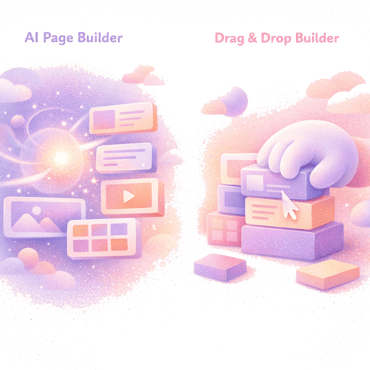
If your team is still choosing between workflows, see AI vs drag-and-drop page builders.
What to ask each tool before you commit
- What does the agency billing look like at 5, 20, 50 clients?
- What’s the team-permissions model? Can my contractor work on one client without seeing the others?
- What happens to client pages when the project ends and we uninstall?
- Is there agency-tier support? What’s the SLA?
- Can I export pages or hand off cleanly to a developer?
The answers reveal more about agency fit than the demo does.
Migrating clients off another builder?
If you’ve inherited a client running PageFly, GemPages, Replo or Instant and want to consolidate on a single tool with cleaner handoff, these step-by-step guides cover the move:
- Migrate from PageFly to Fudge
- Migrate from GemPages to Fudge
- Migrate from Replo to Fudge
- Migrate from Instant to Fudge
For the broader page-builder category, see best Shopify page builders.
FAQ
What's the best Shopify page builder for a small agency?
Depends on whether output ownership matters to your handoff story. If yes, Fudge - the pages exist as theme code and survive without the app. If you'll stay engaged ongoing and don't need handoff, drag-and-drop builders work fine.
Can agencies share one page-builder account across multiple client stores?
Usually not. Shopify apps are installed and billed per store, so each client store normally has its own plan. PageFly, GemPages, Replo and Shogun run partner or agency programs, so ask about their terms for multiple stores. Fudge has a partner program that lists agencies in its expert directory and refers merchants to them.
What's the handoff story when an agency project ends?
For pages built in Fudge: the pages stay as theme code; the client can keep them with no ongoing app subscription. For pages built in drag-and-drop tools: the client needs to keep paying for the builder app or the pages break.
Are AI page builders ready for agency use?
Yes in 2026. The category is mature enough for production work. The trade-off vs drag-and-drop is workflow preference, not capability.
How long does it take an agency team to adopt Fudge?
A few sessions for the prompt workflow to feel natural. Faster for team members already comfortable with AI coding tools.