Key takeaways
- DTC marketing in 2026 is harder than it was in 2020 - paid social CPMs are higher, iOS attribution is opaque, organic reach has plateaued.
- The channels still producing profitable acquisition: Meta + TikTok with strong creative, content-led organic, email + SMS retention, retail partnerships for distribution scale.
- The biggest strategic shift: from “acquire and convert” to “acquire to a brand the customer wants to revisit”. LTV-first thinking is no longer optional.
- The biggest mistake in 2026 DTC marketing: chasing the channel-of-the-quarter without the back-end retention infrastructure to make any channel pay back.
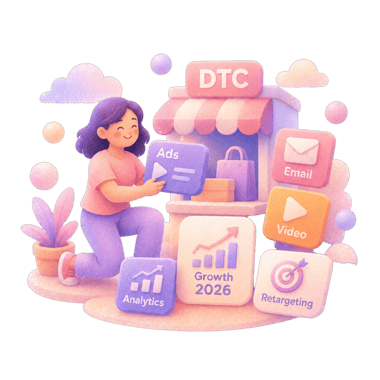
Five channels still produce profitable DTC acquisition in 2026: Meta and TikTok with high-volume creative, content and SEO, email and SMS, retail partnerships, and performance-based creators.
Why you can trust us
We have worked in the Shopify ecosystem for more than four years and have worked with hundreds of DTC brands. We build Fudge, the AI operator for Shopify stores, with a 4.9 rating on the Shopify App Store. DTC brands use it to ship the storefront side of every marketing channel - LPs, PDPs, quizzes, retention pages.
The state of DTC in 2026
Three macro shifts shape the strategy.
Paid social is more expensive
Meta and TikTok CPMs are well above their 2020 levels in most categories. Cold paid social as the dominant acquisition channel is harder to make work profitably.
The brands still winning paid social are the ones with: strong creative (high creative volume, fast iteration), good post-click experience (proper LPs, not generic PDPs), and back-end retention to recover the CAC.
iOS attribution is opaque
iOS 14.5+ privacy changes broke deterministic attribution. Most DTC brands have learned to operate with probabilistic attribution + incrementality testing + post-purchase surveys.
The implication: don’t optimise to ROAS reported by Meta/TikTok. Triangulate with first-party data, blended CAC, and incrementality.
Retention is a moat
LTV / CAC has always been the unit economics. In 2026, the LTV side does most of the work. Brands with strong retention can spend more on acquisition profitably; brands without retention are stuck at the cold-acquisition margin.
The channels still producing profitable acquisition
1. Meta + TikTok with high-volume creative
For most DTC, paid social is still the largest acquisition channel - just harder than before. What works in 2026:
- 5-10 creative concepts per week minimum
- UGC > polished brand creative for cold prospecting
- AI-generated variations of winning creative
- LP-matched ad creative (the ad and the LP look like the same campaign)
- Aggressive iteration on creative format (video > static; vertical > horizontal)
2. Content-led organic and SEO
The slow-build channel that compounds. Blog content, YouTube, educational content tied to product.
- Topical authority over volume - 30 deeply-researched articles beat 300 thin ones
- Video content (YouTube + TikTok organic) is the highest-leverage content medium
- SEO for product-related queries with commercial intent
3. Email + SMS retention
Email is often one of the largest revenue channels for mature DTC brands, and SMS adds to it.
The flows that matter: welcome, abandoned cart, post-purchase, win-back, replenishment. See Klaviyo + Shopify setup for the operational version.
4. Retail partnerships
For brands with product-market fit, retail (Target, Whole Foods, Sephora, REI depending on category) is increasingly a volume and awareness channel.
- Retail expands awareness in ways pure DTC can’t
- Retail revenue is lower margin per unit but higher volume
- DTC margin funds the retail entry; retail volume funds the DTC scale
5. Affiliate, influencer, creator partnerships
Performance-based creator partnerships. Not “we pay $50K for a post” - “we pay 10% commission per sale”.
- Creator-fee + commission hybrid models work for most categories
- Shopify Collabs, Refersion or Impact as platforms for tracking
- Long-tail micro-influencers outperform mega-influencers for most DTC
The math that matters
LTV / CAC
The ratio. Target 3:1 minimum; healthy brands run 4:1 or 5:1. Below 2:1, you’re losing money in real terms after operational cost.
Payback period
How long to recoup CAC. 6 months or less is healthy. 12-18 months is acceptable for high-LTV categories. Above 18 months, you’re a venture-funded experiment, not a business.
Contribution margin per order
After COGS, fulfilment, payment processing, and variable marketing - what’s left. Has to be positive at the unit level; if negative, scale makes it worse.
Repeat purchase rate at 90 days
For consumables: 25-40% is healthy. For considered: 5-15%. For one-time-purchase categories: cross-sell at first visit instead.
Strategic shifts in 2026
From acquisition-first to retention-first
Spending on retention infrastructure (email, SMS, subscription, loyalty) often returns more than the same spend on cold acquisition. The shift in priority is operational, not aspirational.
From single-channel to multi-channel
Brands that grew on Meta in 2020 are diversifying to TikTok, YouTube, retail, and content. Single-channel dependence is the biggest existential risk in DTC.
From volume creative to volume + iteration
Not just more creative; more creative iterated rapidly with learnings from the previous batch. Most brands now run creative as a continuous test rather than discrete campaigns.
From founder-led brand to product-led brand
The founder-as-marketer is still a competitive advantage but no longer sufficient. Product quality, customer experience, and category authority are increasingly what differentiates.
AI shopping agents are a newer surface to prepare for. The free Shopify AI readiness checker scores how visible your store is to them, and the free catalog data audit grades the product data they read.
For wider operational context, see the Shopify CRO guide.
FAQ
What's the best DTC marketing channel in 2026?
There isn't one. Most growing DTC brands run Meta + TikTok + email + organic content + (where it fits) retail. Single-channel dependence is the biggest risk.
Is Meta still worth running ads on?
For most DTC categories, yes. CPMs are higher than 2020 but Meta is still the largest scaled acquisition surface. The bar for creative quality and iteration speed is higher; brands that meet it still make Meta work.
How important is retention vs acquisition?
For mature stores: retention is more important, and established brands often get a large share of revenue from existing customers. For new stores: acquisition gets the customer in the door; retention determines whether the unit economics work.
Should I focus on organic content or paid for a new DTC brand?
Both, but expect timelines to differ. Paid produces revenue within weeks; organic content compounds over 12-24 months. The right answer is paid for revenue + organic for compounding moat.
Is influencer marketing still worth it?
Yes, with performance-based structures (commission, hybrid) rather than flat-fee paid posts. Micro-influencers outperform mega-influencers for most categories.