Key takeaways
- Shopify’s free themes have caught up substantially since the Online Store 2.0 rebuild in 2021. For most stores, a free theme + selective AI-driven storefront edits is a stronger starting point than a paid theme.
- The free themes ship lean and score well on Lighthouse out of the box. Page speed problems usually come from later additions (apps, large images, third-party scripts), not the theme.
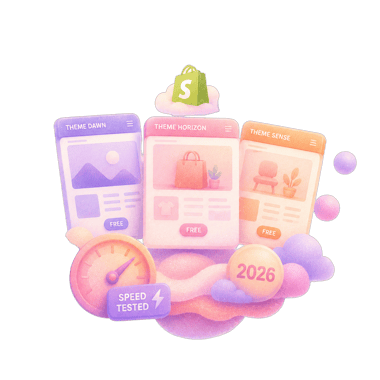
- Horizon has been Shopify’s default theme for new stores since 2025, and Dawn remains the long-standing reference. Sense, Craft, Studio, Refresh, Origin, Crave, Colorblock, and Publisher are the rest of the meaningful free options in 2026.
- The paid theme question is “does it solve a specific structural problem the free theme doesn’t?” If the answer is no, save the money.
The best free Shopify theme for most new stores in 2026 is Horizon, because it is Shopify’s default theme for new stores and ships AI theme and block generation built in. Dawn is still a solid choice, and Sense, Craft and Refresh suit beauty, premium and active brands.
Below is what each free theme is good for, and when a paid theme starts to earn its keep.
Why you can trust us
We have worked in the Shopify ecosystem for more than four years and build Fudge, the AI operator for Shopify stores, with a 4.9 rating on the Shopify App Store. Fudge edits live stores on all of these themes, and the patterns below come from that work.
What Shopify’s free themes have in common
All of Shopify’s free themes (post-2021) are Online Store 2.0. That means:
- Section-based layouts on every page type (not just homepage)
- JSON templates
- App blocks supported
- Metafield-driven content supported
- Modern accessibility baseline (WCAG-aligned defaults)
They differ in aesthetic and in the section library included. None of them differ dramatically in technical capability - all are capable starting points.
A WCAG-aligned default is a starting point, not a finished job. No theme is fully accessible out of the box, so plan to audit your store for Shopify ADA and WCAG compliance once your content and apps are in place.
For a closer comparison of three of them, see Dawn vs Sense vs Craft.
What are the best free Shopify themes in 2026?
Horizon
Shopify’s default theme for new stores since 2025. Shopify introduced it in the Summer ‘25 Edition as its new theme design foundation, with AI theme generation and AI block generation built in, so you can describe a block in plain language and have it generated.
Best for: new stores that want Shopify’s current foundation and its first-party AI block tools.
Trade-off: moving an existing Dawn store to Horizon is a rebuild, so switch only if Horizon solves a specific problem for you.
Dawn
Shopify’s long-standing free theme, and the default for new stores until Horizon replaced it in 2025. Strong baseline aesthetic and a lean build.
Best for: stores wanting a clean, proven base. Many developers and apps still use it as the reference theme.
Trade-off: the default aesthetic is recognisable. Stores that don’t customise heavily look generic.
Sense
Aesthetic leans warm and consumer-soft. Stronger out-of-box hero options than Dawn.
Best for: beauty, wellness, consumer-soft DTC.
Craft
Aesthetic leans crafted, artisan, premium. Heavy use of serif type by default.
Best for: premium DTC, artisan, jewellery, leather, home goods.
Studio
Aesthetic leans editorial and high-design.
Best for: fashion, art, premium lifestyle.
Refresh
Aesthetic leans youthful, athletic, bold colour.
Best for: athleisure, activewear, supplements, food/drink.
Origin
Aesthetic leans heritage and story-led.
Best for: brands with strong founder/heritage stories - food, craft, family-owned.
Crave
Aesthetic leans food-and-drink specifically. Strong recipe / food storytelling sections.
Best for: food, beverage, edible goods.
Colorblock
Aesthetic leans graphic and contemporary.
Best for: accessories, modern home, design-led DTC.
Publisher
Aesthetic leans editorial / magazine.
Best for: brands with strong content / blog component (cookware, design, fashion publications).
Speed comparison
All free themes ship lean. The differences between them on a clean install are small next to what gets added later.
What actually breaks Shopify theme speed is what gets added after install:
- Apps loading their own JavaScript on every page
- Large hero images not properly compressed
- Third-party scripts (chat widgets, tracking, popup tools)
- Page-builder runtimes (drag-and-drop builders’ app SDKs)
If your store is slow, the cause is rarely the theme. See our page builder speed test for the structural speed considerations.
When to pay for a theme
Three conditions where a paid theme makes sense:
1. Specific category templates you’d otherwise build
If a paid theme ships with sections you’d otherwise pay a developer to build - elaborate quiz layouts, specific industry templates, multi-product configurators - the theme price (a one-time $360-$420 for most popular paid themes) is usually cheaper than the dev work.
2. You want a defined aesthetic you can’t replicate
Some paid themes have a strong aesthetic point of view that would take significant design work to replicate on a free theme. If you want that aesthetic, buying the theme is faster.
3. You won’t customise heavily
If your team will run mostly the theme’s out-of-box sections without much customisation, a paid theme’s broader section library extends what you can do without a builder or developer.
When NOT to pay for a theme
-
You’ll be customising heavily anyway. Start with a free theme, customise to your spec. The paid theme’s defaults won’t survive your customisation.
-
You’ll use a page builder for landing pages and PDPs. The theme just handles the cart, collection and account pages. A free theme is plenty.
-
You’re using Fudge, the AI operator for Shopify stores, and its store editor. Fudge drafts custom Liquid, CSS and JavaScript sections on top of a free theme for you to approve, which covers most of what people buy a paid theme for.
A paid theme is also sold to thousands of other stores; sections built for your brand are not.
What we actually recommend in 2026
For most Shopify stores:
- Start with Horizon, Shopify’s default free theme, or Dawn.
- Customise the homepage and PDP to your brand.
- Build landing pages and category-specific sections with Fudge or a builder.
- Move to a paid theme only if you hit a structural limit your free theme can’t address.
For category-specific aesthetics: pick the free theme whose default aesthetic is closest to yours - Sense for beauty, Craft for premium, Refresh for active, Crave for food, etc. If you sell apparel, our roundup of the best Shopify themes for fashion covers the free and paid options for that vertical specifically.
For landing pages and PDPs, see best Shopify page builders.
FAQ
Are free Shopify themes good enough for a real store?
Yes. Many Shopify Plus stores at $5M+ revenue run on customised free themes. The theme is rarely the bottleneck; what you do with it is.
What's the fastest free Shopify theme?
All of Shopify's free themes are lean on a clean install, and Dawn has long been one of the lightest. The differences between free themes are usually smaller than the impact of your apps, images and third-party scripts, so test your own store with Lighthouse or PageSpeed Insights.
Should I pay $360-$420 for a Shopify theme or use a free one?
For most stores, a free theme like Horizon or Dawn plus customisation is the better path. Pay for a theme only if it solves a specific structural problem (industry-specific templates you'd otherwise build, or an aesthetic you'd otherwise pay a designer to recreate). Fudge drafts custom sections on top of a free theme for you to approve, which covers most of what people buy a paid theme for, and sections built for your brand are not shared with thousands of other stores.
Can I switch themes without losing content?
Yes, but section configurations don't transfer cleanly. Plan a theme switch as a rebuild project, not a swap. Test on an unpublished theme copy first.
How often do free Shopify themes get updated?
Shopify updates the free themes regularly - typically several times per year for Dawn, less often for others. Custom themes (paid or developer-built) need maintenance from their author.